Choosing the right manufacturer for Aluminium Pergolas in China requires more than comparing prices. It requires careful research, practical testing, and a clear understanding of outdoor performance. A reliable supplier should control aluminium quality, surface finishing, drainage design, and assembly accuracy. Small details matter. Uneven louvers, weak hinges, or poor seals can become expensive problems after one rainy season.
Martin Chen, an outdoor-structure consultant with experience evaluating Chinese suppliers, says, “A beautiful pergola must still perform when the weather turns.” This simple observation deserves attention. The best Aluminium Pergolas should provide stable shade, controlled ventilation, and dependable rain protection. Their frames should feel rigid, not hollow or poorly joined. Powder coating should remain even around corners, posts, and moving components. Manufacturers should also explain wind-load testing, material grades, warranty terms, and replacement-part availability.
No ranking is perfect. That is worth admitting. Factory photographs can look impressive, while production details remain unclear. A serious buyer should request samples, inspect connection points, and ask how quality checks are recorded. Visiting a showroom helps, but visiting the factory may reveal more. Look for organized assembly lines, covered storage, calibration tools, and staff who can answer technical questions without vague promises.
This guide examines leading Chinese manufacturers through those practical standards. It considers product design, customization, production experience, export reliability, and after-sales support. The goal is not to praise the loudest company. It is to identify suppliers that can deliver attractive Aluminium Pergolas with consistent performance, honest documentation, and useful long-term support. Performance comes first. Design still matters.
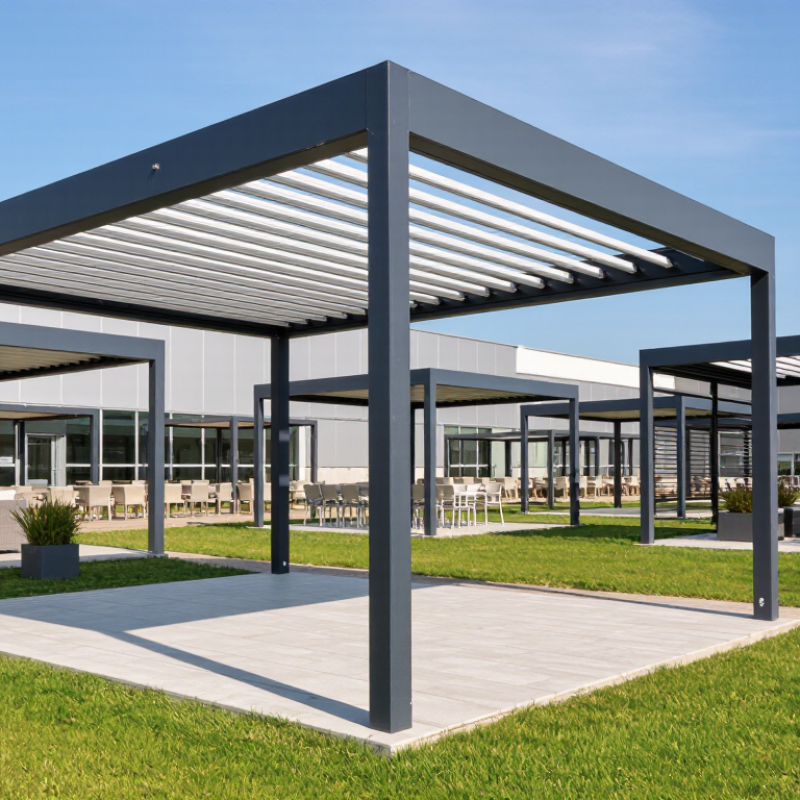
Who Makes the Top Aluminium Pergolas in China?
China produced 41.59 Mt of primary aluminium in 2023, showing the scale of its industrial base. This output supports large extrusion capacity, material testing, and stable supply for pergola manufacturers. However, volume alone does not prove quality. A top aluminium pergola maker should control alloy selection, extrusion accuracy, powder coating, drainage design, and final assembly.
In practical factory assessments, small details often reveal real expertise. Check whether profiles have clean corners, even wall thickness, and secure connection points. Ask for alloy certificates, coating test results, wind-load calculations, and outdoor corrosion reports. A reliable supplier should explain these documents clearly. It should not hide behind impressive production figures. No factory is perfect. Even strong manufacturers may face color variation, delivery pressure, or redesign needs. That deserves honest discussion.
Tips: Request a physical sample before placing a large order. Measure profile thickness with a caliper. Inspect the louver movement, fasteners, seals, and drainage outlets. Confirm whether replacement parts are available. Compare test data with your local climate, not only catalogue claims. A factory’s true capability appears in repeated details. The best choice may not be the largest producer. It is the manufacturer that combines proven aluminium expertise, transparent communication, and consistent quality control.
Choosing a top aluminium pergola maker in China requires more than attractive photographs. The extrusion should be 6063-T5 aluminium, with heat-treatment records and mill certificates available for review. This temper supports good corrosion resistance, surface quality, and practical strength for outdoor frames. Still, alloy names do not prove performance. Section thickness, drainage design, fasteners, and installation tolerances matter just as much.
EN 1090 is a serious screening point for load-bearing aluminium components. It requires controlled fabrication, documented welding procedures, traceability, and competent production management. Buyers should request the factory’s execution-class records and production-control evidence, not only a scanned certificate. ISO 9001 also matters because it formalizes inspection, corrective action, and document control. The ISO Survey 2022 recorded more than 1.26 million valid ISO 9001 certificates worldwide, but certification alone cannot guarantee careful workmanship.
Look closely at the details. A reliable supplier can show alloy certificates, coating-test results, structural calculations, and sample inspection reports. The International Aluminium Institute reported global aluminium production above 70 million tonnes in 2023, yet volume says little about pergola quality. This is where judgment becomes necessary. Some suppliers present polished samples but weak traceability. I would test water drainage, blade alignment, corner rigidity, and coating adhesion before approving a large order. Small oversights become expensive outdoors.
| Evaluation Dimension | Top-Maker Requirement | Recognized Technical Benchmark | What Should Be Verified | Importance for an Aluminium Pergola |
|---|---|---|---|---|
| Aluminium Alloy | Structural profiles are specified as aluminium alloy 6063 with the T5 temper, unless the approved design requires another alloy or temper. | 6063-T5 | Mill certificates, material traceability records, alloy designation, temper designation, and batch identification. | Supports consistent extrusion quality, surface finish, dimensional stability, and predictable mechanical performance. |
| 6063-T5 Temper Definition | The supplier can explain and document the temper condition rather than using “6063-T5” only as a marketing description. | T5 means cooled from an elevated-temperature shaping process and artificially aged. | Heat-treatment or extrusion records and a material certificate linked to the production batch. | Helps ensure that the delivered profiles match the specified strength and manufacturing condition. |
| Profile Standards | Extrusion dimensions, tolerances, and mechanical properties are controlled against applicable European aluminium standards. | EN 755-2 for mechanical properties; EN 755-9 for dimensional tolerances; EN 12020-2 for precision extruded profiles where applicable. | Technical drawings, tolerance tables, inspection reports, and sampling procedures. | Reduces assembly problems, water-ingress risks, visible gaps, and inconsistent fit between beams, posts, and accessories. |
| Structural Execution | The supplier has a documented process for designing, fabricating, inspecting, and assembling aluminium structural components. | EN 1090-1 for conformity assessment of structural steel and aluminium components, where the product falls within its scope. | Factory production control documentation, declared performance information, welding procedures where applicable, and conformity records. | Provides a structured approach to load-bearing fabrication and is particularly relevant for projects supplied into European markets. |
| Execution Class | The manufacturer identifies the applicable execution class according to the project design, use, risk, and structural requirements. | EN 1090 execution classes EXC1 to EXC4, selected by the designer or project requirements. | Project specifications, design responsibility matrix, fabrication controls, and inspection level. | Prevents the same fabrication controls from being applied indiscriminately to projects with different structural risks. |
| Quality Management System | The factory operates a documented and independently audited quality management system covering purchasing, production, inspection, nonconformity control, and corrective action. | ISO 9001:2015 certification with a valid certificate and an appropriate scope. | Certificate number, certification scope, issuing certification body, validity dates, and surveillance status. | Improves process consistency and makes quality issues easier to trace, correct, and prevent. |
| Surface Treatment | Powder coating or anodizing is specified by finish type, coating class, colour reference, and inspection method. | EN 12206-1 for powder coatings on aluminium; ISO 7599 for anodic oxidation of aluminium. | Coating thickness records, pretreatment records, colour and gloss checks, adhesion tests, and batch reports. | Protects the aluminium from weathering and helps maintain appearance in outdoor environments. |
| Corrosion Protection | The design separates aluminium from incompatible metals and controls water traps, drainage paths, and fastener selection. | Use of compatible stainless-steel fasteners, isolating materials where necessary, and designed drainage details. | Connection drawings, fastener specifications, drainage details, and installation instructions. | Reduces galvanic corrosion, staining, trapped moisture, and premature deterioration around joints. |
| Wind and Snow Design | The pergola system is checked for project-specific wind, snow, span, support, and anchorage conditions. | Structural calculations based on the applicable national building codes and project location. | Signed calculations, load assumptions, beam and post spans, anchorage details, and foundation requirements. | Confirms that the system is engineered for the actual site rather than relying on a generic catalogue load. |
| Water Management | Roof louvers, gutters, posts, seals, and outlets are designed as an integrated drainage system. | Defined drainage capacity, sealed interfaces, controlled outlet positions, and installation tolerances. | Section drawings, water-flow paths, sealant specifications, drainage tests, and maintenance instructions. | Helps limit leakage, splash-back, ponding, and water damage around the supporting structure. |
| Dimensional Inspection | Critical dimensions are checked before shipment, including post straightness, beam length, hole positions, louver alignment, and frame squareness. | Documented inspection plan with calibrated measuring equipment. | Inspection reports, calibration records, first-article approval, and nonconformance reports. | Improves installation efficiency and reduces site modification, rework, and alignment problems. |
| Traceability | Materials, finishes, components, and production batches can be traced from incoming inspection through final packing. | Batch codes, inspection records, packing lists, and component identification. | Sample traceability records connecting the delivered product to aluminium, coating, hardware, and inspection documents. | Enables faster investigation and replacement if a material, finish, or component issue is discovered. |
| Product Documentation | The manufacturer supplies complete technical documentation in the purchaser’s required language. | Installation manual, maintenance instructions, technical drawings, spare-parts list, warranty terms, and compliance documents. | Review a complete document package before purchase, not only a product brochure. | Supports correct installation, safe maintenance, warranty compliance, and future component replacement. |
| Factory Capability | The factory has controlled extrusion sourcing, CNC or cutting capability, surface-treatment controls, assembly inspection, and export packing procedures. | Auditable production flow from raw-material receipt to final inspection. | Process-flow chart, equipment list, quality checkpoints, sample inspection records, and independent factory-audit findings. | Indicates whether the supplier can repeat the required quality at commercial volume. |
| Supplier Selection Result | A high-quality supplier is selected only after technical documents, certificates, samples, calculations, and production controls are independently reviewed. | Evidence-based approval rather than catalogue claims or price alone. | Completed supplier evaluation checklist, verified certificates, approved drawings, and signed technical deviations. | Creates a defensible purchasing decision without relying on unverified company rankings. |
China’s aluminium advantage is substantial. The International Aluminium Institute reported about 41.6 million tonnes of primary aluminium production in China during 2023, nearly 60% of global output. However, metal supply does not prove pergola manufacturing capability. Buyers should inspect extrusion presses, powder-coating lines, welding stations, and final assembly records.
Factory capacity is best compared through verified monthly output, not impressive showroom claims. A practical benchmark is 300–1,000 standard pergola sets monthly for a medium producer.
Smaller workshops may accept one to five prototype sets, while established factories often request 20–50 sets for customized orders.
These figures vary by roof design, motorization, and packaging. Samples expose weaknesses.
Lead times deserve equal attention. Standard profiles may ship within 20–30 days after deposit and drawing approval.
Custom tooling, drainage changes, or integrated lighting can add 10–20 days.
The World Bank’s Commodity Markets Outlook shows how aluminium price volatility can affect procurement planning, even when factory capacity appears stable.
Ask for production schedules, tooling ownership, inspection checkpoints, and recent on-time delivery records.
A useful comparison sheet should record monthly capacity, minimum order quantity, prototype charges, tooling time, coating standard, and realistic shipment dates.
Confirm whether capacity includes subcontracted processes. It often does. That distinction can quietly change the schedule.
Experienced buyers also request carton dimensions, loading calculations, spare-part ratios, and a pre-shipment inspection. Factory data is valuable, but independently checked evidence is safer.
China’s strongest aluminium pergola manufacturers prove performance through documents, not attractive brochures. Coating claims should reference AAMA 2604 requirements. These include accelerated weathering, adhesion, gloss, chalk resistance, salt spray, and South Florida exposure criteria. Independent reports should record colour change, coating thickness, and surface defects. Look for actual test dates.
Wind ratings require more caution. There is no universal pergola wind number. ASCE 7-22 calculates design wind pressures from location, exposure, height, and building importance. A reliable manufacturer should provide signed structural calculations and ASTM E330/E330M test records. These records should show positive and negative pressure, test duration, deflection, permanent deformation, and anchor performance. A simple “120 km/h rated” label is incomplete. It may hide weak foundations.
Drainage evidence is equally important. Ask for outlet dimensions, flow rates, ponding-test photographs, and the time required for water to clear. ASTM E331 can support water-penetration evaluation, but it does not automatically certify an open-roof pergola. That distinction matters. During inspection, check concealed channels, corner joints, and leaf screens. One blocked outlet can create a heavy water pocket above a beam. I have seen drawings look excellent while site drainage remained uncertain. The better supplier admits this risk and provides maintenance access. Perfect systems do not exist. Weak evidence does.
China’s scale makes supplier due diligence essential. The International Aluminium Institute reported about 41.6 million tonnes of Chinese primary aluminium production in 2023, nearly 59% of global output. High capacity does not prove pergola quality. Ask for current ISO 9001 certification, factory scope, and the issuing body’s verification link. The ISO Survey 2022 recorded 1,265,216 ISO 9001 certificates worldwide, so certification is common, but its scope still matters.
Request material certificates for alloy grade, coating thickness, and fastener composition. A reliable supplier should match these documents with batch numbers on packing lists. For outdoor pergolas, warranty terms need careful reading. Check coverage for powder-coating failure, corrosion, motors, drainage parts, and labor. A five-year frame warranty may exclude fading, installation errors, coastal exposure, or unauthorized repairs. That wording can change the real value.
Export records offer another practical test. Use customs declarations, bills of lading, and commercial invoices to compare product descriptions, shipment dates, and destination markets. UN Comtrade data under HS 7610 can help review a supplier’s reported structural-aluminium trade history, although HS codes may include products beyond pergolas. Ask for redacted records, not private customer details. Inspect one delivered sample. Small defects matter: uneven louvers, sharp cut edges, water pooling, or loose corner joints. I have found paperwork persuasive, yet physical samples often reveal the uncomfortable gap between compliance and workmanship.
Supplier Due Diligence Framework: Certifications, Warranty Terms, and Export Records
The chart presents a neutral 100-point assessment framework rather than company-specific results. The highest weights are assigned to independently verifiable technical conformity, warranty clarity, and export documentation because these areas directly support product compliance, after-sales accountability, and international transaction reliability.
Look beyond production volume. Check alloy control, extrusion accuracy, coating quality, drainage, and assembly records. Small details matter.
Request 6063-T5 aluminium profiles with mill certificates and heat-treatment records. Measure wall thickness with a caliper. Do not trust labels alone.
EN 1090 supports controlled fabrication and traceability for structural components. ISO 9001 supports inspections, corrective actions, and document control. Certificates still need verification.
Ask for alloy certificates, coating-test results, wind-load calculations, corrosion reports, and sample inspection records. Clear explanations matter more than impressive paperwork.
Compare verified monthly output, not showroom claims. A medium producer may handle 300–1,000 standard sets monthly. Confirm which processes are subcontracted.
Smaller workshops may accept one to five prototype sets. Established factories may request 20–50 customized sets. Design complexity changes these figures.
Standard profiles may ship within 20–30 days after deposit and drawing approval. Custom tooling or drainage changes may add 10–20 days. Schedules can slip.
Test louver movement, fasteners, seals, drainage outlets, corner rigidity, and coating adhesion. Inspect carton dimensions and replacement parts too. Samples expose weaknesses.
Not necessarily. Choose consistent quality, transparent communication, and verified records. A smaller factory may fit better. I would still request independent inspection.
China’s aluminium industry produced 41.59 million tonnes of primary aluminium in 2023, creating a broad manufacturing base for high-quality Aluminium Pergolas. However, production volume alone does not define a top supplier. Buyers should examine the use of 6063-T5 aluminium profiles, compliance with EN 1090, and an effective ISO 9001 quality management system. These factors help indicate whether a factory can deliver consistent structural performance and reliable production standards.
A practical comparison should also cover factory capacity, minimum order quantities, lead times, and customization capabilities. Product evidence is equally important, including AAMA 2604 coating performance, documented wind ratings, and tested drainage systems. Before placing an order, buyers should verify certifications, warranty terms, after-sales procedures, and export records. A transparent supplier that provides technical documentation, clear production schedules, and verifiable testing results can significantly reduce purchasing risks and support long-term project success.