Choosing the right Aluminium Casement Windows requires more than comparing frame prices or attractive showroom samples. Global buyers must examine thermal performance, hardware durability, drainage, glazing, wind resistance, and verified manufacturing quality. The International Aluminium Institute reports that buildings consume roughly one quarter of global aluminium production. That scale makes material efficiency and responsible sourcing important purchasing factors.
Performance matters at the opening.
The U.S. Department of Energy states that windows can contribute approximately 25% to 30% of residential heating and cooling energy use. Well-designed casement windows can reduce uncontrolled air leakage because their sash closes firmly against compression seals. However, results depend on installation quality, glass configuration, frame design, and local climate. A premium profile cannot compensate for poor perimeter sealing.
This guide evaluates leading Aluminium Casement Windows through practical criteria used by architects, fabricators, and international distributors. These include U-value, air permeability, water tightness, wind-load resistance, corrosion protection, thermal breaks, and hardware cycle testing. EN 14351-1 and ISO 10077-1 provide useful reference points for European product performance and thermal calculations. Buyers should still request region-specific test reports.
A ranking is never perfect.
Supplier claims may use different test methods, making direct comparisons difficult. Product samples can also hide weak hinges or inconsistent powder coating. For this reason, the selection focuses on documented evidence, factory experience, warranty clarity, and after-sales support. The best window is not always the most expensive. It is the one that fits the building, climate, code requirements, and installer’s capabilities.
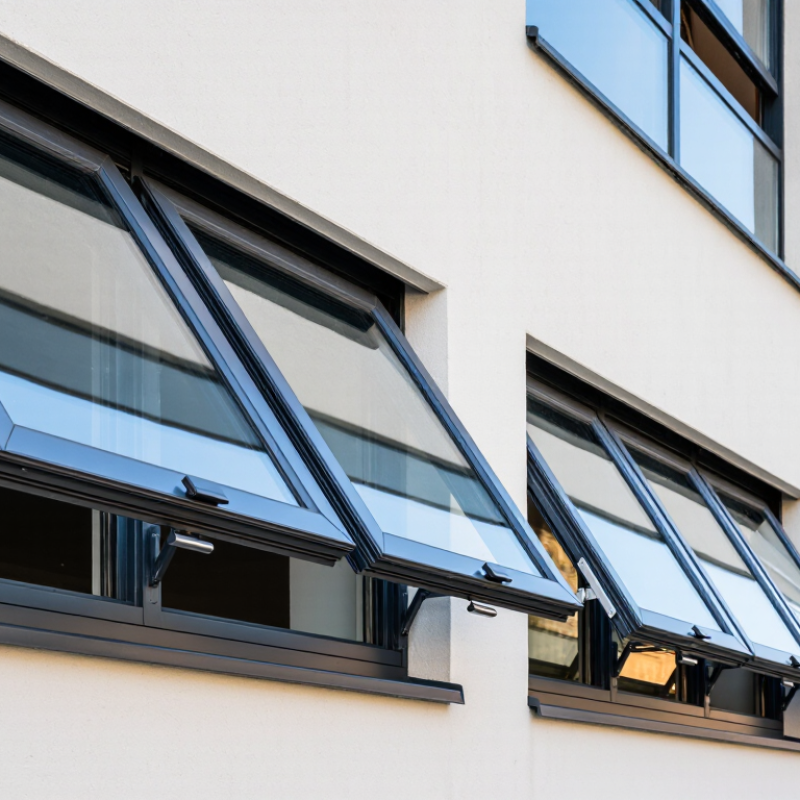
Aluminium casement windows are side-hinged windows that open outward, usually with a handle and friction stay. The sash swings like a door, allowing fresh air to enter across the full opening. Unlike sliding windows, they do not lose ventilation space behind another panel. This design suits kitchens, bedrooms, offices, and coastal homes.
Their aluminium frame is slim, rigid, and resistant to warping. A quality system normally includes thermal breaks, sealed glazing, drainage paths, and durable hardware. These details matter in real installations. For example, a poorly designed drainage channel may allow water to collect after heavy rain. A weak hinge can also make a wide sash difficult to operate. Double glazing improves insulation, while low-emissivity glass can reduce unwanted heat gain in sunny climates.
Global buyers should match the window to local weather and building conditions. Wind exposure, humidity, salt air, and indoor temperature all influence the right specification. Powder-coated finishes can protect the surface, but they still need regular cleaning near the coast. Casement windows can provide strong airflow and clear views, yet outward opening requires space outside. That limitation is easy to miss on crowded balconies or narrow walkways. They are practical, but not perfect. Careful measurement, tested components, and competent installation usually determine whether the window performs well.
Top Aluminium Casement Windows for Global Buyers
Aluminium casement windows use side hinges, allowing the sash to swing outward like a narrow door. Turning the handle moves locking points around the frame. This creates firm compression against the seals. A thermal break separates the inner and outer aluminium sections. It reduces heat transfer through the frame. Double or triple glazing then improves insulation, sound control, and indoor comfort. According to the U.S. Department of Energy, windows can cause 25–30% of residential heating and cooling energy use. The figure varies by climate, glass area, and installation quality.
Designers normally review U-factor, solar heat gain coefficient, visible transmittance, and air leakage. These measurements help global buyers compare products across different climates. In hot regions, lower solar gain can reduce afternoon heat near large windows. In colder regions, improved U-factor and insulated spacers matter more. The International Energy Agency continues to identify building efficiency as a major route for reducing energy demand. Still, a high-performance frame cannot repair a poor installation. That detail is often underestimated.
Tips: Check the hinge capacity before choosing heavy triple glazing. Test the handle with one hand. Ask for certified performance data, drainage details, and replacement gasket availability. Look closely at the corner joints. Small gaps become noticeable in wind-driven rain. Also, remember that published laboratory results are not identical to site performance. Local exposure deserves another review.
Aluminium casement windows use side-mounted hinges and a handle-operated locking system. Air permeability is one important performance factor for global buyers. The chart shows the maximum test pressure associated with each EN 12207 air-permeability classification.
Reference: EN 12207 air-permeability classification. Higher classes require tighter air-leakage performance during testing. Test pressure is shown in pascals (Pa); it is not a direct measurement of annual energy consumption.
Top Aluminium Casement Windows for Global Buyers
High-performing aluminium casement windows should balance thermal control, weather resistance, security, and daily usability. In field inspections, thermal breaks reduce heat transfer through the frame. Low-emissivity glazing can further improve indoor comfort in hot or cold regions. A 1.4-metre sash should open smoothly without noticeable frame movement. Small details matter.
Weather performance depends on more than glass. Multi-point locking systems help maintain compression around the opening. Continuous gaskets limit wind-driven rain and outside noise. Proper drainage channels should guide water away from the sill, even after heavy rainfall. Buyers should request air, water, and wind-load test data for the intended climate. Laboratory figures are useful, but installation quality can change the result.
Hardware should resist corrosion in coastal or humid locations. Powder-coated or anodised finishes need documented durability information. For high-rise projects, restrictors can improve ventilation safety and reduce accidental over-opening. Maintenance access also deserves attention, especially for large buildings. No window performs perfectly. Oversized sashes may feel impressive, yet they can increase hardware wear and adjustment needs. A detailed review of glazing weight, hinge capacity, seals, and local installation practice prevents costly surprises. Specific evidence is better than attractive claims.
| Performance Dimension | Typical High-Performance Specification | Global Buyer Benefit | Common Reference Method or Standard |
|---|---|---|---|
| Frame Construction | Thermally broken aluminium profiles with polyamide insulating strips, typically 18–34 mm wide | Reduces heat transfer while retaining aluminium’s strength, dimensional stability, and slim appearance | EN 14024; regional thermal-transmittance requirements |
| Whole-Window U-Factor | Approximately 1.0–1.6 W/m²·K, equivalent to about 0.18–0.28 Btu/h·ft²·°F, depending on size and glazing | Supports energy efficiency in both heating- and cooling-dominated climates | EN ISO 10077-1; ISO 12567-1; NFRC 100 |
| Air Leakage | High-performing assemblies may achieve ≤0.3 cfm/ft² at 75 Pa, subject to size and testing configuration | Limits drafts, dust penetration, uncontrolled ventilation, and conditioned-air loss | EN 1026 / EN 12207; ASTM E283; local building codes |
| Water Tightness | Typical tested pressure classes range from approximately 300 to 720 Pa for well-designed systems | Improves resistance to wind-driven rain in coastal, tropical, and storm-exposed regions | EN 1027 / EN 12208; ASTM E331 |
| Wind Load Resistance | Common project targets are approximately 1,600–2,400 Pa, with higher ratings available for engineered systems | Provides structural stability in high-rise, exposed, and high-wind applications | EN 12211 / EN 12210; ASTM E330 |
| Glazing Options | Double or triple insulating glass; low-emissivity coating; argon fill; warm-edge spacer; approximately 24–52 mm overall glass thickness | Enables regional optimization of insulation, solar control, daylight, and condensation resistance | EN 1279; EN 673; ISO 10292; IGU manufacturer specifications |
| Solar Heat Gain Coefficient | Approximately 0.25–0.50 for common low-emissivity glazing combinations | Lower values help reduce cooling loads in hot climates; higher values can benefit passive solar heating | EN 410; ISO 15099; NFRC 200 |
| Visible Light Transmittance | Approximately 0.45–0.70, depending on glass layers, coatings, tint, and frame-to-glass ratio | Balances natural daylight with glare control and solar performance | EN 410; ISO 9050; NFRC 200 |
| Acoustic Insulation | Approximately Rw 35–42 dB with suitable laminated or asymmetric insulating glass | Helps improve indoor comfort near airports, highways, railways, and dense urban areas | EN ISO 10140; EN ISO 717-1; ASTM E90 |
| Security Hardware | Multi-point locking, reinforced keep areas, laminated safety glass, and optional key-operated or restricted-access handles | Improves resistance to forced entry and supports different residential and commercial security requirements | EN 1627–EN 1630; local security regulations |
| Glass Safety | Tempered safety glass or laminated safety glass selected according to location, impact risk, and building use | Reduces injury risk and provides additional post-breakage retention where required | EN 12150; EN 14449; EN 12600; ANSI Z97.1 |
| Surface Durability | Powder coating or anodizing selected for the exposure category; marine environments require enhanced pretreatment and coating control | Supports long-term appearance and corrosion resistance in humid, polluted, or coastal conditions | EN 12206-1; ISO 7599; Qualicoat or equivalent coating requirements |
| Operating Durability | Target testing commonly reaches 20,000 opening-and-closing cycles or more for frequently used casements | Reduces maintenance demands in residential, hospitality, and commercial projects | EN 1191 / EN 12400; hardware manufacturer test data |
| Typical Maximum Sash Size | Often engineered around 700–900 mm wide and 1,400–2,400 mm high per sash; exact limits depend on glass weight and hardware | Helps buyers coordinate ventilation, daylight, structural loads, and installation logistics | System-specific structural calculations and hardware load limits |
| Climate Suitability | Adaptable configurations for cold, hot, humid, coastal, high-altitude, and high-wind zones through glazing and hardware selection | Allows one window platform to be configured for different national codes and environmental conditions | Project energy codes, wind maps, moisture exposure categories, and local installation requirements |
Note: Performance values are representative ranges for high-performance aluminium casement window configurations. Final results depend on window size, frame design, glazing, hardware, installation quality, and the applicable regional test standard.
For global buyers, aluminium grade affects strength, weight, and long-term stability.
Extruded 6063-T5 or 6063-T6 is widely used for casement window frames. It offers clean profiles and dependable surface quality. In coastal or high-humidity areas, alloy selection deserves closer review. Ask for mill certificates, extrusion tolerances, and corrosion testing records. A cheaper profile may increase maintenance later.
Finishing changes both appearance and performance.
Anodizing creates a durable metallic surface with a visible grain. Powder coating provides wider colour choices and strong weather resistance. Wood-look finishes can suit residential projects, but colour matching needs careful control. Colour can drift. Request physical samples, coating thickness data, and batch references before production. Small differences become obvious across a large building.
Customization may include thermal breaks, hidden drainage, insect screens, glazing thickness, restrictors, and unusual frame sizes.
Thermal-break systems help reduce heat transfer, especially beside cold glass. The correct option depends on climate, glass weight, wind exposure, and installation quality. A detailed shop drawing should show joints, gaskets, drainage paths, and hardware positions. A perfect sample can still mislead. Site tolerances, packaging damage, and installer habits may change the result. For complex projects, approve a full-size corner sample before placing the final order.
Selecting a suitable aluminium casement window supplier requires more than comparing online prices. Check the supplier’s experience with projects similar to yours. Coastal buildings need strong corrosion resistance and suitable surface treatments. High-rise projects require accurate hardware, safe opening limits, and reliable weather sealing.
Ask for technical drawings, material specifications, and test reports before placing an order. The aluminium grade, wall thickness, glass configuration, and thermal-break design should be clearly documented. Verify performance against relevant local standards, including air leakage, water resistance, wind pressure, and insulation. Samples should show corner joints, gaskets, handles, and drainage paths. Small details matter.
Communication is equally important. A dependable supplier answers technical questions directly and reports production changes early. Request factory photographs, inspection procedures, packaging details, and a clear replacement policy. Confirm whether the supplier can provide installation guidance and after-sales support in your market. A low quotation may exclude accessories, testing, or export-safe packaging. That can become expensive later.
No checklist is perfect. I would still inspect a pre-production sample before approving mass production. Colour consistency can vary between batches, and drawings may not reveal every assembly problem. Ask the supplier to explain risks, not only strengths. Their response often shows more reliability than a polished catalogue.
They are side-hinged windows that open outward. The sash swings like a door, creating a wide ventilation path. They suit kitchens, bedrooms, offices, and coastal homes.
The full opening allows fresh air to enter directly. Unlike sliding windows, no panel blocks part of the opening. Airflow can feel stronger on warm afternoons.
Check the alloy grade, thermal breaks, sealed glazing, drainage paths, gaskets, and hardware. A rigid frame can resist warping. However, a weak hinge may struggle with a wide, heavy sash.
6063-T5 and 6063-T6 are widely used for window frames. They offer clean profiles and dependable surface quality. Ask for mill certificates and extrusion tolerance data.
Anodizing creates a durable metallic surface with visible grain. Powder coating offers more colours and strong weather resistance. Salt air still demands regular cleaning.
Yes, customization can include colour, wood-look finishes, frame sizes, and surface treatments. Request physical samples before production. Colour differences can appear across a large building.
Double glazing improves insulation. Low-emissivity glass can reduce unwanted heat gain in sunny rooms. The correct glass also depends on climate, wind exposure, and sash weight.
The sash needs clear space outside the wall. A crowded balcony or narrow walkway may create problems. Measure the opening, nearby rails, and pedestrian paths carefully.
Drawings should show joints, gaskets, drainage paths, glazing thickness, and hardware positions. Insect screens and opening restrictors may also be included. Details are easy to miss.
Poor installation can reduce drainage, sealing, and smooth operation. Packaging damage and site tolerances may change the final result. A full-size corner sample can reveal mistakes, though it is not perfect.
Aluminium Casement Windows are side-hinged window systems designed to open outward with the help of hinges, handles, and locking hardware. Their practical structure supports effective ventilation, clear views, and convenient operation in residential, commercial, and industrial buildings. This article explains how the sash, frame, seals, and drainage components work together to improve air tightness, water resistance, security, thermal performance, and long-term durability. These features are especially important for global buyers working with different climates, building standards, and installation requirements.
The guide also explores aluminium grades, surface finishes, colours, thermal-break solutions, glazing choices, and customization options for different architectural projects. To select a suitable supplier, buyers should assess material quality, manufacturing consistency, testing capabilities, customization support, packaging, communication, lead times, and after-sales service. A careful comparison of technical specifications and project requirements can help buyers choose Aluminium Casement Windows that deliver reliable performance, attractive appearance, and value throughout their service life.